
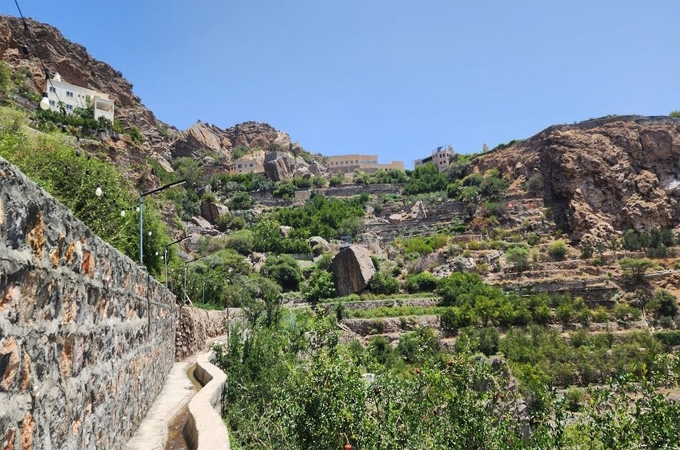
The Wilayat of Al Jabal Al Akhdar in A’Dakhiliyah Governorate, Oman is witnessing a wave of youth-led initiatives that reflect a strong spirit of innovation and entrepreneurship.
Set against a backdrop of natural beauty and cultural and
tourist landmarks, these projects attract visitors from across Oman,
particularly during the summer months when Al Jabal Al Akhdar enjoys mild
weather.
Among the standout initiatives are the “Eider” rest house
project in the village of Saiq, the “Planting of 300 Olive Trees” initiative in
Al Manakhir, the restoration of the historic village of Al Suwajrah, and the
“Rummanah” (Pomegranate) project.
Together, they offer visitors distinctive experiences that
showcase indigenous tree species, unspoiled nature, Omani customs and
traditions, heritage sites and local crafts — including the rose distillation
industry for which Al Jabal Al Akhdar is famous.
Project owners told Oman News Agency (ONA) that their
initiatives have helped revitalise tourism and economic activity in the area.
They provide visitors with an introduction to sustainable
agricultural tourism, demonstrate how to harness agricultural resources for
tourism and share success stories that have become an inspiring model for
heritage revival and sustainable development.
Ali bin Nasser Al Falahi, owner of the “Eider” rest house in
Saiq, said the idea for the project emerged in response to the growing number
of tourists visiting Al Jabal Al Akhdar year after year. Such heritage
projects, he noted, activate community tourism and boost income for productive
families and local artisans.
He used natural materials from the local environment —
various types of rare stone for agricultural terraces and pine wood for
balconies and outdoor seating.
Other spaces were planted with local fruit trees such as
pomegranate, grapes, peaches, walnuts, apricots, olives and figs.
The rest house also features imported varieties, including
jujube and ornamental trees.
To appeal to visitors seeking a tranquil atmosphere, Al
Falahi added outdoor seating, cabins, a café serving coffee and juices and
swimming pools suitable for all ages.
He also plans to expand the project in the future by
offering a wider range of services to meet tourist needs.
Abdullah bin Nasser Al Shuraiqi, a resident of the village
of Al Suwajrah, said that after the last inhabitants left in 2014, the
village’s young men launched an ambitious initiative that brought life back to
the community.
Meticulous restoration of traditional buildings began, and
the implementation of a sustainable tourism model helped transform the village
— more than 400 years old — into a unique destination attracting thousands of
visitors from around the world.
Al Suwajrah today offers a cultural and tourist experience
that highlights Oman’s rich heritage and proves that young people can turn
challenges into opportunities for growth and prosperity, he said.
In the first phase, efforts focused on restoring old houses
and converting them into heritage inns using local materials such as stone and
gravel, and the timber of ancient trees — including al‑Al‘alan, al‑Otum and al‑But
— for roofing, to preserve traditional Omani architecture.
Infrastructure development included a suspension bridge of
ropes and wood to improve access, paved agricultural paths, cobbled alleys and
directional signboards, Al Shuraiqi added.
Construction and operational costs between 2020 and 2025
reached about RO 500,000 (1.3 million), with work continuing to further develop
the village, Al Shuraiqi said.
He added that Al Suwajrah offers visitors a unique range of
experiences: heritage accommodation, craft workshops (wood carving and Omani
coffee making), mountain adventures, unspoiled nature, traditional farming,
sheep herding, and handicrafts such as stick‑making and traditional cooking. In
2025, the village received more than 30,000 visitors, with over 700 overnight
guests.
The village is known for landmarks including Aamer Cave and
the Hidden Lakes, Al Shuraiqi said.
Activities include stargazing, the Pomegranate Trail and Via
Ferrata climbing.
Interactive maps and updated event schedules have been
introduced, and social media platforms enable direct booking of rooms,
accommodation and food services.
He pointed out that the ancient village of Al Suwajrah
embraces sustainability as a fundamental pillar across three dimensions.
Environmental sustainability is achieved through reducing
plastic use — cutting costs by 75 per cent — and using sustainable local timber
from trees that have died or been affected by natural factors, such as al‑Otum,
al‑Al‘alan and wild olive.
Social sustainability comes from employing and training
local community members and reviving traditional crafts such as al‑Otum stick‑making
and carpentry.
Economic sustainability is secured by creating new job
opportunities for villagers and opening income channels through tourism and
online sales of local products.
Mahmoud Al Tobi, Trustee of Endowments for the village of Al
Manakhir, said the project to plant 300 olive trees, part of the public
endowment for the village, is overseen by the Ministry of Endowments and
Religious Affairs.
It holds great long‑term environmental, social and economic
importance for Oman and was implemented at a cost exceeding RO 62,000.
The idea arose because the olive tree is long‑lived and
evergreen, enhancing the village’s appearance, ensuring abundant production and
promising returns from the harvest for the public endowment, Al Tobi said.
Added to this is the global quality of Al Jabal Al Akhdar
olive oil, which has earned international recognition.
The initiative includes high‑quality saplings from the Diwan
of Royal Court’s nursery, focusing on three varieties: Koroneiki, a small Greek
variety producing oil with up to 28 per cent content; Coratina, an Italian
variety with high oil density reaching 27 per cent; and Arbequina, a Spanish
variety common in intensive farming, known for its fruity flavour.
Production is expected to begin next year, with olives to be
marketed in Oman and internationally.
The project was supported by Petroleum Development Oman
(PDO), Oman LNG, Bank Muscat, Galfar company and a community contribution from
villagers.
The initiatives respond to local market needs, aiming to
enhance the tourist experience and empower Omani youth to invest in the tourism
assets of Al Jabal Al Akhdar, particularly in areas of high tourist appeal that
have become a primary destination for entrepreneurial projects supporting
sustainable local development.