
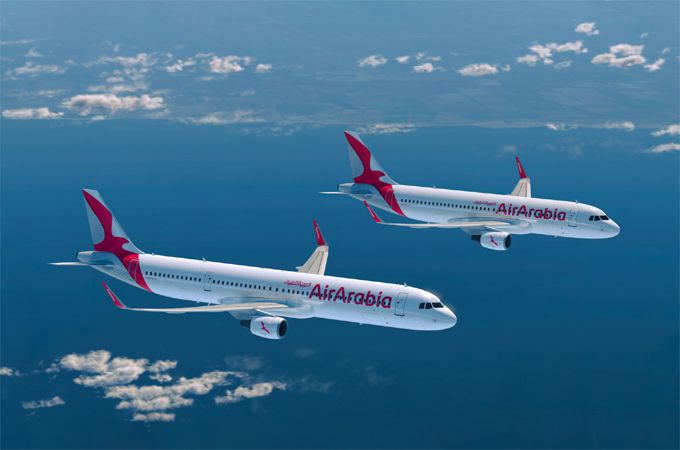
Air Arabia reported a 42 per cent year-on-year decline in net profit to AED 383 million ($104 million) for the third quarter of 2026, despite a 10 per cent increase in revenue to AED 2.31 billion, as regional conflict, higher fuel prices and operating cost pressures weighed on its financial performance.
The Middle East and North Africa’s first and largest
low-cost carrier operator said it carried more than 5.7 million passengers
across its operating hubs in the three months ended September 30, down 3 per
cent compared with the same period last year. The average seat load factor
stood at 82 per cent.
The airline attributed its quarterly performance to
sustained passenger demand and revenue growth, which helped offset the impact
of higher operating costs and fuel price volatility.
Commenting on the results, Sheikh Abdullah Bin Mohammad Al
Thani, Chairman of Air Arabia, said: “We are pleased to have recorded our third
consecutive profitable quarter this year amid a challenging operating
environment. The ongoing regional conflict continued to weigh on the overall
operating environment, driving higher costs, fuel price volatility, and
persistent supply chain constraints, which in turn impacted profitability.
Despite these challenges, we are proud to have delivered a solid net profit for
the quarter, supported by revenue growth and sustained demand for our
value-driven product.”
Nine-month profit declines 47%
For the first nine months of 2026, Air Arabia recorded a net
profit of AED 757 million, down 47 per cent from the corresponding period last
year. Revenue increased 2 per cent to AED 5.81 billion, compared with AED 5.71
billion in the first nine months of 2025.
Passenger numbers across the Group’s operating hubs declined
10 per cent year-on-year to 14.4 million, while the average seat load factor
remained steady at 83 per cent.
Al Thani said: “Our focus on operational efficiency,
disciplined cost control, and network optimization has enabled us to deliver
solid financial and operational performance during the first nine months of the
year, despite the regional and global economic challenges. These results are a
testament to the agility of our management team, the continued trust of our
customers, and the strength of our multi-hub business model.”
Saudi expansion boosts network
Air Arabia continued to expand its regional footprint during
the period, launching operations from its newest hub at King Fahd International
Airport in Dammam on September 20, 2026. The new operation began with domestic
services to Jeddah, Madinah and Riyadh.
The launch followed the granting of an Air Operator
Certificate by Saudi Arabia’s General Authority of Civil Aviation to the new
national budget carrier established by an Air Arabia-led consortium comprising
Nesma Group and KUN Investment.
Across its network, the Group introduced 14 new routes
during the first nine months of the year across the UAE, Morocco, Egypt,
Pakistan and Saudi Arabia, bringing its total network to 224 routes.
The airline also added 10 aircraft during the period, taking
its fleet to 100 owned and leased Airbus A320 and A321 aircraft. Four
additional aircraft are scheduled to join before the end of 2026.
Looking ahead, Al Thani said: “For the remainder of 2026, we
remain confident in the fundamentals of our business and in the flexibility our
multi-hub model gives us to respond as market conditions evolve. We will
continue to invest in our fleet and expand our network where we see sustained
demand, while maintaining the financial discipline that allows us to offer
reliable, affordable travel and create long-term value for our stakeholders.”
Sustainability and community initiatives
Air Arabia was named “Most Sustainable Low-Cost Airline in
the MENA Region 2026” by World Finance Magazine under its annual Sustainability
Awards Programme.
The airline also highlighted the impact of its Charity Cloud
initiative, which has supported communities across its network and beyond
through passenger donations onboard since 2007.
The programme has invested in 168 projects across 27 countries, benefiting more than 450,000 people through healthcare, education and humanitarian initiatives. -TradeArabia News Service