
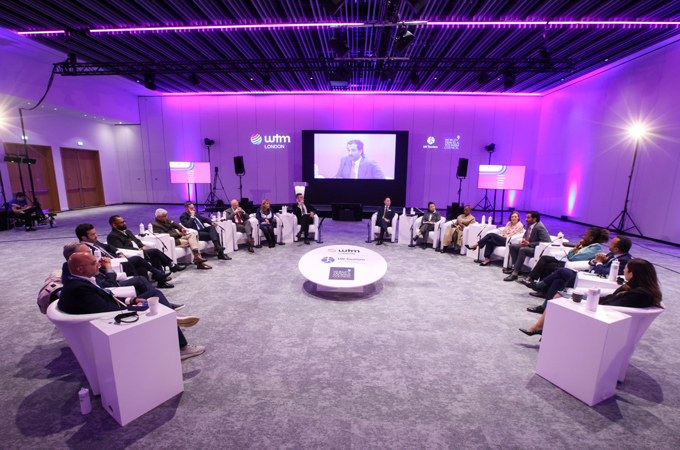
Tourism ministers and industry leaders from around the world have discussed the impact of geopolitical conflicts, climate change, sustainable development and the distribution of tourism wealth at the 20th anniversary WTM Ministers' Summit, held during World Travel Market (WTM) London 2026.
Held in association
with UN Tourism and the World Travel & Tourism Council (WTTC), the annual
summit brought together 50 tourism ministers under the theme ‘Strengthening
Tourism for a Resilient and Regenerative Future’.
Discussions focused on
how destinations can strengthen their resilience against external shocks,
address environmental challenges, distribute tourism benefits more widely and
improve the sector's contribution to national economies.
Geopolitical
challenges and recovery
The impact of this
year's Iran conflict and its consequences for regional tourism was among the
key topics. The UAE's tourism minister praised the private sector for
maintaining confidence and keeping prices moderate during the disruption, while
highlighting government support through measures such as postponing fees.
He cautioned
businesses against reducing prices below operating costs, saying: “If you go
down more than cost price, it takes about three or four years to build that
back up,”
Qatar also reported a
recovery in aviation demand, with airline load factors returning to February
levels by August.
“If it happened again,
we wouldn’t go back to airspace fully closed,” the minister commented.
The WTTC forecast a
swift recovery for tourism across the Middle East, highlighting the sector's
ability to respond to geopolitical disruption and restore visitor confidence.
Climate change and
sustainable tourism
Environmental
resilience was another major focus, particularly for African destinations
facing growing climate-related challenges.
Zimbabwe's tourism
minister called for greater international cooperation to address environmental
pressures, saying: “Climate change knows no boundaries. In a different way, it
brings us together.”
Zimbabwe is investing
in deep boreholes and dam construction to improve drought resilience and
protect its natural resources, which are central to its tourism industry.
“Besides saving the
people, we want to save the animals because they are the cornerstone of our
tourism,” the minister pointed out.
Nepal's tourism
minister also highlighted the impact of climate change, following devastating
floods in the country this year. He warned that the country's natural heritage,
including its mountains, flora and fauna, faces increasing environmental risks.
The discussions
underlined the importance of protecting natural attractions and strengthening
climate adaptation strategies to safeguard destinations and the communities
that depend on tourism.
Spreading tourism
benefits beyond major destinations
The summit also
examined how governments can distribute tourism activity more evenly, helping
address overtourism while extending economic opportunities to less-visited
regions.
The UK government
representative highlighted the role of local authorities and regional
decision-making in achieving this objective.
“devolution is a
really big part of this,” she said, outlining plans to increase the spending
powers of city mayors and emphasising the importance of improved transport
connectivity.
Croatia is using
visitor surveys and research to identify investment priorities, with health
tourism emerging as one of its development areas.
The country's minister
revealed that 70% of government tourism grants were being directed towards
projects in less-visited inland regions, while coastal funding was largely
supporting improvements to existing businesses and higher service standards.
Croatia is also
participating in a project to measure tourism's environmental impact, including
energy consumption and waste generation, alongside its regional economic
contribution and impact on GDP. The minister said the findings had already
helped change perceptions of tourism's wider value.
Measuring tourism's
economic contribution
The debate also
addressed the importance of measuring tourism through economic value rather
than visitor numbers alone.
The UAE minister
stressed that destinations should focus on the spending and economic
contribution of visitors rather than simply the number of arrivals.
“It’s not the airlines
that come in and how many tourists we receive, it’s about the value the tourist
leaves in your city.”
Bulgaria is
strengthening tourism research through closer links with education and
universities. Its minister outlined ambitions for the country to become “a
world leader” in universities specialising in tourism.
The government is
identifying 200 universities for a major new programme, with a second phase
involving the establishment of an observatory to monitor key performance
indicators (KPIs) across the tourism sector.
“We cannot manage any
more with only a feeling” the minister stressed, highlighting the need for
reliable data to guide policy and investment decisions.
Meanwhile, a UN
Tourism project is helping Zimbabwe measure tourism's economic contribution,
following the sector's role in supporting the national economy during mining
and agriculture crises in 2024.
Supporting local
businesses and communities
Sierra Leone's tourism
minister highlighted the importance of connecting local businesses with wider
supply chains to ensure tourism generates economic opportunities at community
level.
The country is using
gastronomy as a platform for development, creating opportunities for local food
producers and community-based businesses. Women involved in cooking at
community hubs, for example, can also become suppliers to tourism projects.
A chatbot supported by
UN Tourism is also helping domestic travellers plan journeys across Sierra
Leone, with the aim of inspiring further travel and supporting destination
discovery.
India's minister
described tourism as a “self-resilient sector”, attributing its strength to the
resilience and commitment of stakeholders across the industry.
Greater
public-private sector collaboration
A new format at this
year's summit brought private-sector representatives directly into discussions
with government ministers, highlighting the importance of collaboration in
tourism planning and development.
An entrepreneur
highlighted Africa's significant contribution as a source market for Middle
Eastern tourism, while a representative from MSC Cruises stressed that
private-sector businesses should be involved at an early stage of government
tourism planning.
Visa also outlined how
its spending data has helped governments better understand traveller behaviour
and identify where visitors spend their money.
Gloria Guevara,
interim CEO at the WTTC, highlighted tourism's importance to global employment,
noting that one in nine jobs worldwide depends on the sector.
She said: “we need the
public sector, we need the policies, we need the right support and to work as
one voice with the private sector.”
Khanh Linh Vu,
Principal Advisor to the Secretary-General of UN Tourism, also emphasised the
importance of international cooperation, stating: “No one can build a resilient
tourism sector alone.”
The 20th anniversary summit reinforced the need for governments, tourism businesses and international organisations to work together to address geopolitical and environmental challenges, strengthen local economies and ensure tourism growth delivers wider social and economic benefits. -TradeArabia News Service