

AROUND the region overseas tourist boards have been keen to attract Middle East visitors, particularly in the downturn.
TTN spoke to Austria, in the west, and Singapore in the east, to find out how 2009 turned out and what is planned for 2010.
Singapore was on track to achieve its forecast of nine to 9.5 million visitors for 2009 and, as of September, it had received received 87,755 visitors from the Middle East, a 1.8 per cent increase over 2008.
Jason Ong, area director, Mena, Singapore Tourism Board (STB), said: “While we are starting from a small base, the Middle East is an important market for Singapore due to the strong growth potential.”
The figures for Austria were 26 million arrivals between January and September with 82,700 of them coming from the Middle East.
Agreeing with his Singapore counterpart, Klaus Ehrenbrandtner, director Middle East of the Austrian National Tourist Office – Dubai, said: “The Middle East’s number might look quite small but it is the fastest growing market and has become the third biggest overseas market after North America and Japan.”
In fact such has been Austria’s focus on the region that arrivals have increased by 165 per cent in the last five years.
“The global recession did not have a big influence on Austrian tourism,” said Ehrenbrandtner. “We had some decrease in numbers from countries that were badly affected by the credit crunch such as the UK and Spain but at the same time visitors increased from our neighbouring countries of Switzerland and the Czech Republic.
“From the Middle East we had an immense increase in arrivals in the first half of the year. From January to June we had a plus of 31.9 per cent in guests from this region so I doubt that the global recession was a big factor. Unfortunately the panic about the H1N1 virus was, so we had a lot of cancellations in the period when the media hype was strongest.
September brought a big rise again with 76.7 per cent more arrivals from the Middle East.”
The top Middle East visitor sources for Austria are Saudi Arabia, the UAE, Kuwait and Qatar and while Singapore is also popular with Emiratis and Saudis, it is also attracting significant travellers from Iran.
 |
|
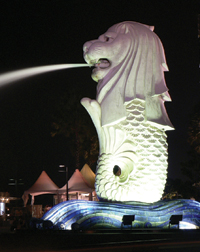
The famous Marlion (mermaid and lion) statue at the Theatre on the Bay, |
Ong said: “2009 has been a challenging year for the tourism industry with the global recession as well as uncertainty over the H1N1 virus adversely affecting travel sentiments.
Our tourism forecast of nine to 9.5 million visitors, while it is a decline from last year’s 10.1 million, is an accurate reflection of this challenging year.”
In fact, he added: “We saw visitor arrivals to Singapore gradually bottom out and in September 2009 Singapore registered a growth of 7.1 per cent in visitor arrivals signalling a gradual improvement to the situation.
“We look forward to an exciting 2010 as Singapore unveils a host of exciting developments such as the launch of two new integrated resorts (projects which offer hotel and leisure facilities alongside casinos, amusement parks and various other attractions) Marina Bay Sands and Resorts World Sentosa.
“Resorts World Sentosa will have Southeast Asia’s only Universal Studios theme park which is located within Singapore’s massive family destination resort, Resorts World Singapore. In total Universal Studios Singapore will feature 24 rides and attractions, 18 of which are either original or adapted for the park.”
To keep the visitors coming there will also be world-class shopping and dining options in these and other developments which the STB is widely promoting.
This is also a landmark year for Singapore as alongside opening the two new integrated resorts, it will also host the world’s first Youth Olympic Games in August.
In Austria there are several new projects to look out for including the recently launched Swarovski Wien, a must-see destination combination of art gallery, shop and architectural masterpiece following the success of Swarovski Crystal Worlds which was launched in 1995 and has become Austria’s second most-visited sight after the Imperial Palace in Vienna.
And building on its success Austria will continue combining business-to-consumer and business-to-business activities including the Acts training programme for travel agents, in which they can become an Austrian Certified Travel Specialist, plus familiarisation trips, promotions and road-shows.