
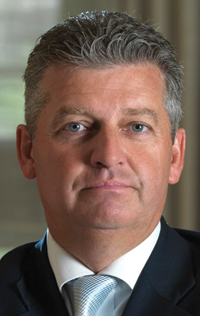
Craig Senior, director of sales and marketing, Middle East and Indian Sub-Continent for the Jumeirah Group tells TTN what’s in store for the future.
How was 2009 in terms of occupancies and revenue per available room (revpar) for the properties in the region?
In 2009, we did see a change in our market segments as compared to previous years. A positive sign has been that our main source markets, which are predominantly the European and Middle East markets, started to show a positive return in quarters three and four of 2009. These trends have continued in the first quarter of 2010. The biggest impact in the first half of 2009 was from the UK market, it also was the quickest to recover and rebound between July and December 2009.
At Jumeirah, our beach properties have remained strong with guests returning from the UK and other European markets. The beach hotels are currently running at an average occupancy of 90 per cent and have been trading in the mid-high 80 per cent for most of the quarter.
Room rates are lower than in 2008, which is a natural fundamental change that has happened, but in terms of revpar, we are doing very well, which is currently being driven by the beach properties.
Do you see a shift in loyalty with guests asking for better value in these tough times?
Customers obviously have a much wider choice these days and loyalty is a key factor. One of our core fundamentals is our repeat-guest loyalty factor, which is very strong and continuously increasing. We combine that with our ‘Stay Different’ concept across our portfolio.
While the leisure markets have remained healthy, what is Jumeirah’s strategy to bring back business travellers?
If you look at the Jumeirah portfolio, the majority of our Dubai properties cater largely to the leisure segment because of their physical locations. With regards to business travellers we have Jumeirah Emirates Towers, a unique core city hotel in Dubai, as well as our properties in London and New York. We are annually involved with the RFP corporate rate submission process and work very closely with our key corporate partners.
 |
|
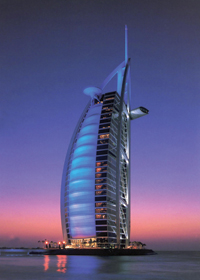
Burj Al Arab |
Jumeirah is continuing its growth into 2010. Our expansion plan is to grow our portfolio to 60 hotels by 2012, this plan is well underway with projects currently under development in the UAE (covering Dubai, Abu Dhabi and Al Ain), Jordan, Qatar, Oman, Bahrain, Kuwait, Morocco, the Maldives, Bali, Thailand, China, Argentina, Panama, Spain, England, Scotland, Germany and the US Virgin Islands.
2011 will see the opening of our properties in Kuwait, Aqaba and Shanghai, whilst Jumeirah Frankfurt, in Germany, will open later this year. So the pipeline of development is strong and on schedule.
What kind of brand awareness does Jumeirah have in these new markets?
We have been fortunate because of the existing presence of our global sales offices in most of these countries. For example, we have an existing sales team in Germany and our property in Frankfurt is expected to open by the end of 2010. So, we have recognition and a presence already in Germany and this will support our Frankfurt property. The same applies in China and Singapore for Asia Pacific as well. In the Americas, we have dedicated teams in Chicago and New York.
India is also a key market for us. We have plans to enter the market, first and foremost in the form of a sales structure while we study the market for future development plans. We hope to make an announcement on this in the near future.
What kind of year was it for Jumeirah’s seven-star Burj Al Arab?
The Burj Al Arab performed very well in its own market segment. There is a specific clientele and market for the property. The European markets have always been quick to bounce back and this was certainly the case in the first quarter of 2010. The Russian market, which is also an important feeder market, returned quickly too. With occupancies more than 80 per cent in the first quartre of 2010 as well as positive rate levels, Burj Al Arab continues to remain a niche product for the company and our valued partners and guests alike.