
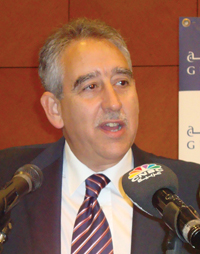
BAHRAIN'S national carrier Gulf Air has taken hits from the high oil prices, global downturn and regional competition. It has seen three chief executives attempt to turn its operations around since 2002, and has now chosen Samer Majali, a veteran of the industry who has been credited with the reversal of fortunes at Royal Jordanian, to steer the carrier. MAJALI, speaking to SREE BHAT, expressed confidence that the airline can ride through the difficulties with the right kind of leadership
Excerpts from the interview:
Do you see any similarities between the problems faced by Royal Jordanian and now your new airline?
Part of my attractiveness, from the point of view of Gulf Air, was that this turnaround was done with an Arab carrier and an airline that was government-owned. So there are similarities, but the solutions will be different because there are major differences as well.
Jordan is surrounded by Iraq, Israel, Palestine and Lebanon and has had to contend with the political issues that affect the movement of tourists and investment into the area. That was the key challenge in turning around Royal Jordanian.
With Gulf Air, it is different in that the political issues are not so much apparent here, but competition is. We are facing severe competition from three larger cousins, who are well-established and quite well-funded. But the environment is similar at least within the company.
What is the mandate given to you by Gulf Air’s owners?
I have the mandate to do everything it takes to put the airline on a solid commercial footing over the next few years and to improve the product to a level that is deliverable, consistent, reliable and value for money – a product which everyone in Bahrain can be proud of.
In your opinion, what is the main problem facing Gulf Air today?
The main problem is that the airline has identical route structures to that of its competitors. It targets the same markets as all of its larger competitors and therefore it is in a position of being a follower rather than a leader.
The revenue is out of line with the cost. Again, it is because our route structure is not ideal, we do not have the leadership in any of the routes. We hope Iraq and other new routes will provide Gulf Air the leadership role which we are seeking.
What is the biggest challenge you face?
Changing the mindset of the staff is a huge challenge. It’s easier to change the fleet and routes, but changing the attitude of staff is difficult. But we have to do that to survive. We have to convince them that this is in their best interest and that of the company.
I have come to Gulf Air alone. The airline has a great talent pool and given the right kind of leadership, I am sure we will be able to succeed.
What is the time-frame for the restructuring and when will it show results?
We have started reviewing the airline’s business model and will put in place a new plan of action with a series of clear recommendations by the end of the year.
The airline will undertake a comprehensive engagement process with all key stakeholders and audiences including customers, employees, the Gulf Air Union, the business community and government. The objective is to develop a sustainable business that serves the needs of the travelling public and supports the growth of the national economy.
Gulf Air is currently not sustainable and is receiving subsidies, which could otherwise be invested in other parts of the national economy.
The restructuring will aim at making the airline commercially viable and the plan should start yielding results in a year’s time.
Do you see Bahrain Air as a major rival?
Airline business is a tough one and I don’t think Bahrain is of a size that can handle two airlines. Our competitors in neighbouring countries do not allow competition to be established outside of their group. Healthy competition, from my point of view, comes from everybody else flying in here and not from a carrier that is started from Bahrain. I think we have adequate competition from all the other airlines that are flying in. The market is very well-served and the addition of Bahrain Air adds zero value from the competition standpoint. It probably makes both of us weaker.
You have recently launched flights to Iraq despite some concerns over the security situation there. What made you take this plunge?
We’ve been studying flights to Iraq over the last year and these studies have looked at all the aspects - commercial, operations and security. The studies show that flying to Iraq holds the same level of risk as any other flight on our network. If we did not have the utmost confidence in our studies, then we would not do it.
If there are any security issues, the company will not hesitate to suspend flights as it values the security of its customers, staff and assets.
There is speculation that as part of your revamp, some staff will lose jobs. What is the situation?
No decisions have been made yet in this regard and it would be premature to say anything now as this is the purpose of the review we have started. Our key priority is to safeguard jobs. Gulf Air has an enviable pool of talent, expertise and knowledge. We need to secure this asset as an integral part of the airline’s business and long-term future.
We are trying to lower the manpower through natural attrition, through people who are retiring or are at the end of their contracts.