
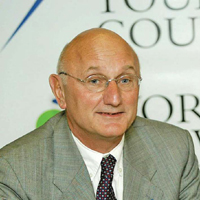
JEAN-CLAUDE BAUMGARTEN, president and CEO of the World Travel & Tourism Council (WTTC), was at the World Travel Market in London recently. He caught up with Cheryl Mandy
Can you give a general overview of how the economic crisis is affecting the tourism industry worldwide?
This crisis is a very unique one. It is hard to make an estimation in terms of figures, but we see a slowdown. Nobody knows exactly what will be the disposable income in the coming months and year, which means everyone is moving very cautiously. So we consider that next year will be tough. We will have a significant slowdown in growth and the industry is gearing up for a dive in the economic situation. The consumer will spend less; travel less yet most probably domestic tourism will increase. Of course there will be some areas of the world that remain solid such as parts of China, Russia and there will be strong residual traffic coming from Europe particularly the UK.
The need to travel is universal; it is almost a fundamental right. And if people want to travel, people will continue to do so.
The crisis will have an impact on jobs or course, but the industry is ready. Companies have tightened up their ways of doing business, coming out with products that are more adaptable. That is the magic of our industry – we are ready to go through difficult times and we are ready to bounce back, our resilience is amazing!
How about in the Middle East?
The Middle East has developed a very viable, solid travel and tourism economy, in large part because of the extremely strong growth in intra-regional traffic over the past few years – since 2000 anyway - which in our view is going to continue to build stability in the region.
How has the industry come along towards adopting responsible tourism?
In the last year we have seen big changes. We have seen a conjunction of two elements – the consumer is asking more and more about the responsible behaviour of the tourism service providers and they in turn are more engaged in corporate responsible behaviour which includes the environment. It becomes not only a moral responsibility, but also an economic requirement. It makes economic sense to be responsible – it is good for your bottom line. And when there is a joint approach between moral value and bottom line things advance fast.
Have the Tourism for Tomorrow Awards helped raise the profile of responsible tourism?
We at WTTC consider the awards have a symbolic value in two fields, environment and community. We recognise companies that have a very dedicated product or type of behaviour. We cannot be successful in our business now if we don’t have a sense of including the community in what we do. The awards and the success of them is that all people involved become part of the community – the consumer wants the experience, for the service provider it makes economic sense to use local products, labour, provide assistance eg houses, hospitals, school etc – all this helps give these communities a reason to accept travel and tourism on their turf. This market is going to grow, but it will do so in niches.
In your opinion, how has the Middle East region tackled responsible tourism?
The Gulf has created something unique in the world. It has helped the progress of the whole Middle East region. Travel and tourism is in some of these regions already recognised by their leaders as of the utmost economic importance. The other aspect is that there is a fantastic social phenomenon in this region, particularly in the Gulf where 60 to 70 per cent of the population is coming from all over the world. This mix of nationalities and cultures has been successfully put together and that is something of a hidden treasure.
As regards hotels in this region adopting this policy, there has in the last two years been really big progress. It simply is not good management if you don’t have aspects of responsible tourism incorporated into your hotel.
The next WTTC summit – please tell us about this.
We decided to go to Brazil for the 2009 summit because in a difficult environment it symbolically follows what we at WTTC strongly believe, that travel and tourism will grow very robustly in the middle and long term. We believe that new destinations will come and new markets will emerge, and Brazil represents this. It is a fantastic untapped travel and tourism potential; it is also a country where the president is strongly convinced about the importance of travel and tourism to his economy. Besides, it’s fun country to be in!
[See more information on the summit on page 15.