
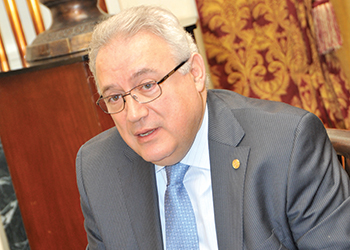
The maturing hospitality market in the Middle East has a lot of room for growth, particularly in the budget and midscale segments, Dr Amine Moukarzel, president Golden Tulip Hotels, Suites & Resorts, Middle East and North Africa (Mena) tells TTN in an exclusive interview.
'As we speak, we’re opening three properties in Kuwait, which bring us back into Kuwait after an absence of 10 years,' he says, counting two more properties coming up in Algeria, including the five-star Royal Tulip. There is another one of those opening in Bahrain, couple more in Beirut and in Doha. Saudi Arabia will have 16 properties open by 2017. With Golden Tulip growing from 43 hotels in 2011 to 60 hotels at the end of 2012, Dr Moukarzel heads the fastest-expanding hotel management company in the Mena region. Combine its portfolio of Golden Tulip Hotels, Suites & Resorts and Louvre Hotels, and it becomes the second largest European group and the eighth largest worldwide with its brands: Royal Tulip, Golden Tulip, Tulip Inn, Kyriad, Campanile and Premiere Classe. 'Saudi remains our largest target for opening of hotels; we’re opening our second hotel in Madina. We hope by this September to open a 350-room hotel in Makkah,' he says. 'Once we are in Doha in September October this year, it will put us in the position of having a hotel in every Arab capital.' The brand is growing in every way. 'From an average of 80-90 rooms in a large hotel, we will go to 150 rooms average in the next few years, especially with the new rooms under management agreements,' says Dr Moukarzel. Those are not the only numbers he is proud of. A veteran of 34 years in the UAE, Dr Moukarzel is happy to share anecdotes that illustrate the rapid growth of the hospitality market in the country. 'In my previous stint, I was as the head of hospitality of a leading group of companies headquartered Abu Dhabi. We built the Crowne Plaza on Sheikh Zayed Road at the time. Then, no one believed the growth that Dubai may get not only for itself but for its sister emirates and neighbours as well. 'When we presented the drawings for the Crowne Plaza at the municipality for approvals, it was refused because of the 23-storey height. It finally happened after we signed an undertaking with Emirates Telecommunications Corporation that we would approve a booster on the roof for telecom waves. 'And to think that now, we have the highest and tallest and best building in the world,' he says.Midscale and budgetThe region is ready for more, he says, charting the course of hospitality growth in the region, which has its fair share of luxury. 'Midscale hotels are the highest in demand in the region. Budget hotels are coming up. These are definitely needed for the next generation. This is what the market has realised. 'We’ve have reached a level that budget hotels are a necessity. If you go back to the 70s, there was only government spending on hospitality, when they were looking for a venue to hold the Arab League meetings. 'We have seen other hotels have been built in the 80s and the 90s. Now midscale is growing all the way to reach budget hotel level,' he says. The veteran hospitality professional is generous with his advice and has several insights to share. 'Budget hotels have to be operated in a cluster. You cannot operate at the standards that luxury brands are used to – having a general manager and a front office for every property,' he says.
Tips and tricksSharing growth figures for the last year, he says that in Dubai the group’s four-star midscale hotels closed at 80-82 per cent occupancy with an average rate of Dh450.His mantra for tough times is not to give in to lower pricing. 'We can do better if the yield management exercise is performed better by competitors. But the reality is that if a new hotel opens, the prices go down by even 40 per cent.' 'My advice is to take a management approach. This means, do not go down substantially when the occupancy goes down. The conventional advice is to lower your rates to get more volume. I say, you should give better value and better service or perks – offer lunch perhaps,' he says. Technology, availability of talent and up-to-date product will define the hospitality market for the next couple of years to come, he says. 'The most important trend will be related to technology, whether it is to do with the implementation of IT in the backend or social media. The second will be talent development and sustaining talent. Human beings are the most important.' Ask him about the toughest markets to open hotels and he says: 'The most difficult to attain is, in fact, the most desirable – it’s Lebanon due to the coexistence in a hostile neighbourhood. When I studied hotel management in Lebanon it was the only school in the region. We had students from developed hotspots of tourism such as Africa, Tunisia, Morocco and Egypt. Today, much of the manpower is abroad; hotels and tourism are suffering.' August will see the Golden Tulip Achrafieh open in Lebanon. Dr Moukarzel says, 'This year will witness our strongest development achievements. We have built in terms of project development and construction in the last two years. The momentum will continue in the next year. 'Our brand equity due to the partnership with Louvre hotels has added value to the offering. We’re going to keep our momentum in 2016, 2017 and beyond in the budget sector.' Golden Tulip Hospitality Group, Mena Region can be found on stand number HC7320.
By Shalini Seth
***************************************************************************************************************************Scheduled openingsGolden Tulip is all set to open hotels in Algeria, Bahrain, Lebanon, Oman, Qatar, Saudi Arabia and Tunisia this year. Next year, the brand will open further properties in Georgia, Syria and the UAE. For a comprehensive list of upcoming Golden Tulip properties, visit www.ttnworldwide.com.***************************************************************************************************************************