

Łódź (pronounced ‘wooch’) is the third-largest city in Poland after Warsaw and Krakow, and though not as well-known as its larger counterparts, it best represents the changing face of Poland.
The story of Łódź, as it stands today, is one of regeneration and rebirth and of the indomitable human spirit. The city has had an eventful history, lending it an interesting mix of architecture and stories. Once the industrial centre of Europe, the city was led to ruins two World Wars later, and the textile industry gradually moved to the East.
TRACING BACK
In 1820, Stanisław Staszic helped grow Łódź from a small settlement into a modern industrial centre. Immigrants came to the ‘Promised Land’ (the city's nickname) from all over Europe: mostly from southern Germany, Silesia and Bohemia. This is visible in the culture and gastronomy of the neighbourhood.
In 1825, the first cotton mill was commissioned, marking the beginning of the city’s golden age as it transformed into the main textile production centre of Europe.
Karl Wilhelm Scheibler, one of the most important industrialists in Łódź at the time, built several factories in the city. The years 1870 to 1890 marked the period of the most intense industrial development in the city’s history.
The Great Depression and two world wars later, the most profitable and productive era for Łódź had drawn to a close. Most of its bigger factories had been nationalised under the Third Reich and all the machinery was moved to Germany, leaving behind empty buildings that once supported the livelihood of a city.
The nation slowly started picking up the pieces after the war and by the 1990s industries were privatised again and the silver lining was visible again.
A NEW BEGINNING
The textile industry never picked up in Łódź quite in the same way as before, but it left behind stunning architecture from the bygone era, giving the city a unique character. Building on the blocks left behind by centuries, Łódź has the vibes of a young city now.
Some century-old factories have been converted into modern lofts, others have been converted into museums and malls, and yet some house glitzy four-star hotels.
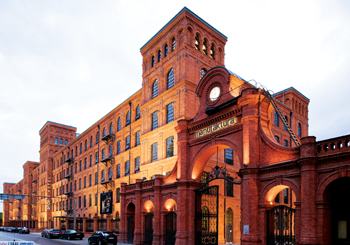 |
The entrance to Manufaktura, a shopping and recreation complex, and a glimpse of andel’s Hotel Lodz |
Take the Film Museum, for instance, which took over the former palace of industrialist Scheibler, together with the carriage house and courtyard, to document the history of Polish cinema.
The exhibits include some old professional and amateur camera makes, film installations and an original (still in working condition!) 19th century photo-plasticon by the August Fuhrmann company.
Łódź is a hallowed name in film history, having tutored the likes of Roman Polanski, Krzysztof Kieślowski and Andrzej Wajda, filmmakers who have changed the way the world looks at cinema.
Piotrkowska Street, one of the longest commercial streets in the world at over five kilometres, is the high street of Łódź and the place to go shopping, eating or clubbing. A sculpture of pianist Arthur Rubinstein can be seen on Piotrkowska Street in Łódź, where Rubinstein was born and raised.
At the head of Piotrkowska, is textile magnate Poznański’s palace, an impressive and imposing 19th century structure that is home to the Museum of the City of Łódź today. Around the palace are red brick-buildings, all of which were once part of Poznański’s textile empire, spinning mills and related factories.
Behind the L-shaped palatial residence of Poznański, is Austrian hotel operator Vienna International’s four-star andel’s Hotel Lodz, built in a way which exemplifies the city’s industrial past in an eclectic and artistic way.
Near the hotel is a culture and retail complex called Manufaktura, also built inside what once was Poznański’s factory complex.
Today, Manufaktura offers a stylish and unique shopping experience of mid- to high-scale brands, and is surprisingly quite affordable. The currency currently used in Poland is not Euro but Polish Zloty, which makes all the difference. The country has plans to migrate to Euro eventually.
Though Łódź is not counted among the most prosperous cities in Europe, the area is blessed with natural greenery. There are fields, forests and parks in abundance, and farms where different kinds of honey are produced. Poniatowski Park makes for a good stroll in particular, but most lanes and bylanes of the city offer an ample glimpse of greenery. Freshly plucked raspberries are sold in abundance on the roadsides and are a must buy.
By Rashi Sen