

A HEALTHY and therapeutic climate, breathtaking landscapes and the healing powers of the three elements – water, air and earth make Germany an ideal destination to replenish your energy levels, find deep and lasting relaxation, and holistic cures.
With more than 1,000 wellness and beauty hotels, 350 quality-certified health resorts and spas and a fabulous range of specialist clinics, Germany is creating a new awareness in the Middle Eastern health tourism scene.
The Naheland, alongside the river Nahe in south eastern Germany is dotted with a number of well-being resorts and spa complexes offering superb mineral and thermal baths, clay therapies, special spa treatments, Kneipp, thalassotherapy and Ayurveda as well as organic cuisines.
Menschels Vitalresort in Bad Sobernheim (‘Bad’ means ‘bath’ in German, and symbolises a health resort) is located within a spacious park with old trees and surrounded by meadows, wood and vineyards. The facility has been a member of Wellness-Hotels & Resorts Germany for more than 15 years and since 2004 a member of BIO-Hotels.
Vitalresort offers its unique Felke clay bath, based on Emanuel Felke’s (1856-1926) “healing earth” therapy, a source of soothing natural energy. Two doctors are on call 24-hours a day. “Of the average 2,000 guests a year we welcome each year, the percentage of those coming from the Middle East is still low,” says Dr Matthias Menschel, owner.
“Ninety-five per cent come from within Germany, and most of the rest from the neighbouring countries,” he adds, noting that he sees a huge potential in the Middle East and North Africa as interest in German wellness tourism is mounting with new awareness programmes launched by the German National Tourist Board (GNTB).
Another attraction is the Bad Sobernheim Barefoot Path (Barfusspfad) offers visitors take a 3.5-kilometre path on alternating terrain, interacting with grass and clay, sand, stone and bark chip, all working like a foot reflexology massage and helping stimulate the entire body.
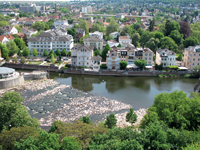 |
The path begins at the clay pool and works its magic across countryside scenery, offering opportunities as varied as picnics, testing one’s balancing skills and crossing the Nahe River via a 40-metre suspension bridge or a boat. The foot trail also introduces visitors to the geological history of the region featuring rocks and surfaces narrating 300 million year old stories of the natural landscape. The Technical University Darmstadt offers guided tours along the Nature trail.
Barely 80 km from Frankfurt is Bad Kreuznach, a typical pretty German town, offering some of the best, state-of-the-art spas in Germany. Perfect for out-patient treatment, the 4,000 sq m Crucenia Health Centre has a team of doctors, medical pool attendants and masseurs. Crucenia also offers its own special sea salt grotto where close to 17.5 tonnes of salt has been used from Jordan’s Dead Sea to form 12,000 bricks. The warm and dry air in the grotto, containing 21 minerals – half of which are not found in Europe, add to a pleasurable experience in the Crucenia Thermen.
“The pure ionised air in the salt grotto, in combination with relaxing music and gentle lighting, benefits those suffering from lung, bronchial, heart and vascular diseases,” says Dr Michael Vesper, managing director, Bad Kreuznach Health & Tourism. The natural therapy and the atmosphere in the grotto are also popular among families with children, especially children suffering from respiratory diseases.
The Spa Centre (Baderhaus) in Bad Kreuznach offers 11 saunas and steam baths, a swimming pool, a saltwater pool, a whirlpool and an outdoor pool on the roof garden. The variety of saunas include Finnish, gemstone and meditation saunas, Roman baths, oriental or Moorish baths, Turkish and Scheherazade baths and wellness massages. It also offers classic and pampering massages, shiatsu and beauty baths such as the Cleopatra or goat butter cream bath. The old-world charm Baderhaus Alpine sauna, which has a stone bath and millwheel shower, is the centre of attraction on the roof terrace.
“Bad Kreuznach has a European-wide unique spa treatment in the form of radon therapy in a radon tunnel,” explains Dr Vesper. The air in the radon gallery, carved inside a hill, contains a low and harmless concentration of the radioactive gas – radon. By activating the immune system through radon therapy, illnesses such as asthma, respiratory diseases and especially rheumatism are successfully treated, says Dr Vesper.
Bad Nauheim, again on the Nahe trail, is where you literally sip into your well-being. The Trinkkuranlage (drinking cure complex) constructed more than a hundred years ago, is an astonishing piece of architectural heritage offering the healing effect of natural springs rising from over 200 metres underground. A perfect place to enjoy the bubbly, soothing warmth of the water is the Therme am Park (thermal bath at the park), surrounded by soothing underwater sounds and stimulated by air bubbles and massaging water jets.
Even the ancient Romans were aware of the healing and beneficial impact of the 26 hot springs of Wiesbaden. Today, Wiesbaden visitors can enjoy the thermal water in both the Art Nouveau-style Kaiser-Friedrich-Therme and the modern Thermalbad Aukammtal.
Germany saw a record number of international arrivals at more than 1.03 billion in 2012, out of which Middle East travellers accounted for 52.6 million. GNTB estimates this figure will hit 149 million in 2030, claiming a market share of 8.2 per cent of global visitors as against 5.1 per cent in 2012.
Germany also ranks second after Switzerland as an international travel destination compared with 140 countries worldwide, says GNTB’s 2013 competitiveness index.
Meanwhile, Middle Eastern visitors to Germany spent an average of 308 euros ($415) on tax-free shopping in the first half of 2013, marking an increase of 25 per cent over the same period of 2012, according to a report from Global Blue.
By Ravi Kalmady