
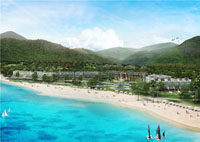
Banyan Tree Group announces the upcoming launch of Vietnam’s first world-class integrated resort, Laguna Lăng Cô, on November 1, 2012. Nestled along the coast of tranquil Central Vietnam, Laguna Lăng Cô is Banyan Tree’s first foray in the country, and echoes the ethos of Laguna Phuket, the company’s flagship integrated resort community in southern Thailand.
Framed by a 3 km beach and lush countryside, the 280-hectare community resides near Lăng Cô Bay in the Chan May region overlooking the East Sea, an area renowned for its pristine coastline, tropical jungles, rugged mountain peaks and proximity to the country’s most storied Unesco World Heritage Sites, including the cities of Hue and Hoi An along with the relics of My Son. The development is nestled in a unique crescent bay offering privacy and unparalleled exclusivity, and will include Banyan Tree and Angsana branded hotels and spas, an 18-hole championship golf course designed by Sir Nick Faldo, private villas and residences available for sale, convention facilities and a plethora of recreational activities for guests of all ages. Laguna Lăng Cô is poised to become the leading world-class holiday and premium second home destination in Southeast Asia.
Phase 1 of the project represents a $200 million investment funded through the Banyan Tree Indochina Hospitality Fund, the first real estate investment fund established by the Group in 2008.
“Banyan Tree has long been interested in establishing a presence in Vietnam to replicate the success of our flagship integrated resort in Phuket,” stated Ho KwonPing, executive chairman of Banyan Tree Holdings, Ltd. “Central Vietnam is an ideal foothold for our inaugural development in Indochina with its natural beauty and areas of rich historical interest such as Hue and Hoi An. We are confident that Laguna Lăng Cô will flourish as a holiday and premium properties destination for both domestic and international luxury tourism.”
Banyan Tree Lăng Cô offers a luxurious retreat from which to explore the culturally rich destination of Central Vietnam. Inspired by the artistic heritage of Vietnamese dynasties past, the resort features 32 one-bedroom lagoon villas (131 sq m) and 17 one-bedroom beach villas (124 sq m) set on the shores of Canh Duong beach. A spa highlights Banyan Tree’s award-winning treatments and services, while a Marine Centre provides opportunities to learn about and explore the vibrant waters of the East Sea.
Banyan Tree’s sister hotel, Angsana Lăng Cô, is a contemporary getaway featuring 229 stylish suites, 100 of which come equipped with their own private pools. All suites in every room category feature picturesque mountain, lagoon, or sea views, and incorporate local materials such as bamboo and Mother of Pearl, along with traditional arts with a contemporary twist, lanterns and elegant framed calligraphy.
The resort residences present an array of ownership opportunities with luxurious villas and condominium units offering spectacular ocean views. Taking inspiration from Vietnamese traditions and culture, each elegant one-, two- or three-bedroom villa (from 158 sq m – 236 sq m) of Banyan Tree Residences Lăng Cô features a private plunge pool and world-class facilities along with the discerning service sensibility for which the group is renowned. Limited villas are available for sale, and ownership confers membership in Banyan Tree’s worldwide luxurious private residential community.
Angsana Residences Lăng Cô showcases the rich history of Vietnam with a modern twist. The first three-storey beachfront condominium development of its kind in Vietnam, each one- or two-bedroom Angsana Residences home features a contemporary aesthetic complemented by a modern plunge pool and breathtaking sea views.
The Laguna Lăng Cô Golf Club, an 18-hole, par-71 championship course designed by Sir Nick Faldo, delivers a golfing experience that can be enjoyed by skilled and novice players alike. The site’s natural rugged terrain has been preserved, offering a distinctive course with changing landscape framed by mountains on three sides and the East Sea to the west. The course weaves between soaring trees, flowing streams, verdant rice paddies and dramatic rock features, and are noted for their oceanfront footage.