
AS is the case for many European legacy airlines, these are challenging times for Lufthansa, the continent’s largest.
The German company reported €13 million ($16.2 million) losses for 2011, blaming the Eurozone crisis, high fuel costs, intense competition (particularly from state-owned Gulf airlines), and a government-imposed night flight ban at Frankfurt Airport, its main hub.
Compounding the sense of gloom the International Air Transport Association (Iata) recently forecast that European carriers would amass $1.1 billion total losses this year.
Against this background, Lufthansa executives will have been glad to share some good news with the world’s travel trade media as they unveiled the latest elements of the airline’s fleet expansion programme and premium cabin overhaul in a Frankfurt Airport hangar in late May.
In pride of place in the vast hangar was a brand new Boeing 747-8 Intercontinental, the first of 20 launch customer Lufthansa has ordered for phased delivery up to 2015. Strategically, it envisages the $317 million aircraft filling the niche between its existing 747-400 and Airbus A380 fleets.
The first 747-8 I entered commercial service on June 1, flying 362 passengers - eight First Class, 92 Business Class and 262 Economy Class – from Frankfurt to Washington DC. As more aircraft are delivered, it will serve Bangalore, Delhi, Chicago and Los Angeles, the airline says.
For its outlay, Lufthansa says it gets a plane which, although 5.6 m longer than its predecessor – the 747-400 –is 15 per cent more fuel efficient than comparable long-range aircraft. Impressively it is, Lufthansa claims, approximately 30 per cent quieter than the 747-400, a fact most noticeable in a First Class cabin Lufthansa has branded ‘the world’s quietest’, which also has outer skin insulation, sound-absorbing curtains and sound-deadening materials in the floor.
Although the new aircraft is not earmarked for the Frankfurt-Dubai route – currently served by a 747-400 –Lufthansa’s Middle East passengers can at least look forward to experiencing the airline’s new Business Class product. Unveiled at the ITB Berlin in March, it is now being progressively rolled out across the 100-strong long-haul fleet as part of a €3 billion ($3.78 billion), four-year cabin retrofit programme.
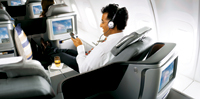
According to the airline, the new Business Class seat, developed in close consultation with passengers since 2007, converts to a 1.98 m long horizontal bed, as well as offering additional storage space and an enhanced entertainment system, with 15-inch screens.
“We integrated our customers very closely into the development of our new Business Class so we would be able to offer a product totally in line with their wishes and requirements,” explains Jens Bischof, Lufthansa board member responsible for Sales and Revenue Management.
“The horizontal sleeping surface is a crucial factor for our passengers. This request was the focus for all our other considerations,” he says.
Seating in the new Business Class cabin is in an innovative ‘V‘ shape - two neighbouring seats are angled towards one another along a central axis, an arrangement which virtually doubles the distance between two neighbouring seats at shoulder level, giving greater privacy.
According to Lufthansa, the seat has ergonomically-improved cushioning to ensure a high degree of comfort in a sitting or horizontal position, as well as lowerable armrests providing more space in the shoulder area when lying down.
The new Business Class seat is a major component of Lufthansa‘s largest investment to date in its inflight product, and the airline says it complements other features of the premium travel experience, including additional free baggage allowances and fast-track security lanes, a particularly welcome feature at the busy Frankfurt hub.
Lufthansa’s Middle East customers will await the new Business Class product with much anticipation.
By Mark Lazell