

While Egypt is keen to launch an ITB Middle East version, experts believe too many shows will dilute the trade fair landscape
SMARTING from the huge balance-of-payments deficit of $5.65bn in the last quarter of 2011, Egypt made a strong pitch as “partner country” at the recent International Tourism Bourse (ITB) in Berlin to lure back foreign tourists, with Egyptian tourism minister emphasising that it is an “absolutely safe” destination unaffected by last year’s political uprising. To further lend weight to its efforts, Egypt has been prodding Messe Berlin, the organiser of ITB Berlin, the “mother of all tourism shows”, to stage an ITB Middle East in Cairo.
Egypt’s quest for ITB Middle East is, however, not going to be realised because, as many experts at ITB were saying, there are already too many shows around the world and one more show will only dilute the trade fair landscape and confuse the trade.
Holding a Middle East version of ITB has been close to the hearts of Egypt’s tourism strategists who could present it as proof that the country is back to its former “business-as-usual” status. The event would attract a large turnout of both exhibitors and trade visitors from around the world and, particularly, the Middle East, leading to greater tourism traffic to the country.
Egypt depends heavily on foreign tourists. Tourism revenue, which made up about a tenth of the country’s GDP, dropped to $8.7bn in 2011 from $12.5bn a year earlier, according to central bank figures. Egypt’s economy has been battered ever since the outbreak of the popular uprising accompanied by protests and riots, frightening away tourists and investors.
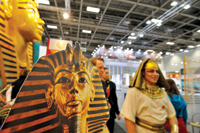
Egypt’s pavilion at ITB, designed as a replica of the Karnak Temple, became a beehive of activity, with Egypt’s tourism minister Mounir Fakhry Abdel Nour and the country’s tourism ministry officials receiving a steady stream of visitors, including the media.
In an interview with TTN, Nour emphasised that the situation in Egypt had calmed down after last year’s turmoil, and that the country’s “tourism sector would revert to the 2010 level when traffic had peaked”.
 |
Egypt, which clocked nearly 10 million tourists in 2011, has set a target of 30 million tourists for 2017, according to Nour. To achieve this ambitious target, Egypt will have to go all out to attract tourists. ITB Middle East could be one such vehicle to lure tourists who could fill in fast-depleting state coffers.
The excessive media coverage of protests and riots, some Egyptians were saying in Berlin, had kept away many foreign tourists from visiting the country. Putting things in perspective, Nour said that “although Tahrir Square is only a square kilometre of Egypt, it is being wrongly projected as the entire country”.
Organising ITB Middle East in Cairo would also lend credence to the Egyptian claim that the country had become a safe destination and demonstrate to the world that there was no interference from the new political leadership in the country’s tourism policy.
Nour also maintained that Egypt’s revolution had opened a new chapter in its history, making the country democratic and free, and creating an environment conducive to holding ITB Middle East.
Feelers to Messe Berlin
Egypt had already sent feelers to Messe Berlin, the Berlin trade fair company which organises ITB Berlin, to stage a Middle Eastern version of the show in the Egyptian capital. After all, Messe Berlin has been organising an Asian version of the event in Singapore called ITB Asia since few years.
Messe Berlin’s chairman and CEO, Raimund Hosch, who is well respected as an authority on international tourism, confirmed in an interview with TTN that Egypt had indeed expressed an interest in having a Middle Eastern version of its show in Cairo. But Hosch, like many other German tourism experts, felt that there were already too many tourism shows worldwide. “We cannot simply keep exporting our ITB brand show all over the world,” he said. “No doubt, Egypt is an exciting destination and unique in many ways. It fascinates foreign tourists, including many from Germany who regularly visit that country. But it would not be realistic for us to do it (organise ITB Middle East in Cairo) because there are already a few shows that specifically cover the Middle East and North Africa,” Hosch explained.
“Dubai, for example, organises Arabian Travel Market which serves the Middle East,” he added.
Over and above that, Egypt faces competition from other venues that are vying for such an event. Abu Dhabi and Morocco, for example, are the other contenders that have shown an interest in staging an ITB Middle East show. “At this point, it would not be realistic to expect another show for the Middle East,” Hosch said.
There is also the view amongst German experts that an event must have a long-term viability and not be of an ad hoc nature. That, say many German tourism gurus, would go against the grain of a sound business strategy.
By Manik Mehta