

SOCIAL media, the newest weapon in the arsenal of marketers, is extremely efficient and the fastest evolving tool to date.
Companies can now converse with, as opposed to ‘talk to’ their target niche on a highly effective platform that allows them access to unprecedented insights into consumer behaviour. Platforms like Facebook and Twitter have taken relationship marketing and permission marketing to a whole new level. But don’t blink yet, the next step in social networking and media is already here and it is telling you where to go and who to meet.
Location-based networking is based on the idea of letting users interact based on their physical location at a given time. The idea is to get a user to ‘check-in’ to a venue from a list presented based on your location determined by your mobile phone’s GPS. If the venue doesn’t exist the user is allowed to add it to the database. Upon checking-in, the user is able to see if any of his friends are at the same venue, or in locations nearby, access tips from users who may have been at the venue before and find recommended places in the vicinity.
 |
Foursquare, one of the many location-based services, incentivises users by awarding points for check-ins and the title of ‘Mayor’ to a user who may have checked into a particular venue the greatest number of times.
Given its obvious benefits in the area of loyalty marketing, the early adopters in the hospitality industry have signed on rather quickly. But they aren’t the only ones who stand to benefit from this. In an economic climate where businesses and governments are looking to grow tourism from residents as much as they are from tourists, location-based networks can prove to be an invaluable tool.
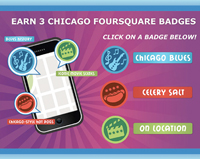
The city of Chicago in Illinois, US, has set up an elaborate campaign featuring – among other social networks – a partnership with Foursquare enticing users to explore the city and its diverse neighbourhoods. Users can earn three custom Chicago-themed badges by checking-in at any of the locations relevant to the Chicago theme. Instead of only relying on tourists from other states, Chicago has gone ahead and given its very own residents a reason or three to explore the city.
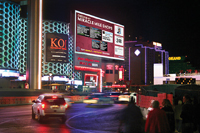 |
Other platforms have been used to serve an integrated social media campaign. Las Vegas, for example, lists Foursquare check-ins on a huge digital billboard showcasing the user and the message sent out. Something as simple as that can incentivise users to be a little more social.
Of course these are only two of many ways in which location-based networks can be used by the tourism industry. With online social networks inching closer to offline social networks and ‘Where are you now?’ becoming the ‘What’s on your mind?’ the users certainly seem to be adopting the newer trend of technology and marketing, even if it is at a steady pace. The question remains, will businesses and governments adapt and adopt fast enough to keep up? Fortunately or unfortunately, they are just going to have to.
* Bhavishya Kanjhan works for Socialize, a social media agency & training house based in Dubai and can be contacted at www.socialize.ae
by Bhavishya Kanjhan